The 1993 Precedent · Sources
Sources
The documents behind the argument. Primary Nazarene records come first, with page images where they can be shared. Copyrighted books and articles are cited, not reproduced.
The 1990–93 committee: primary documents
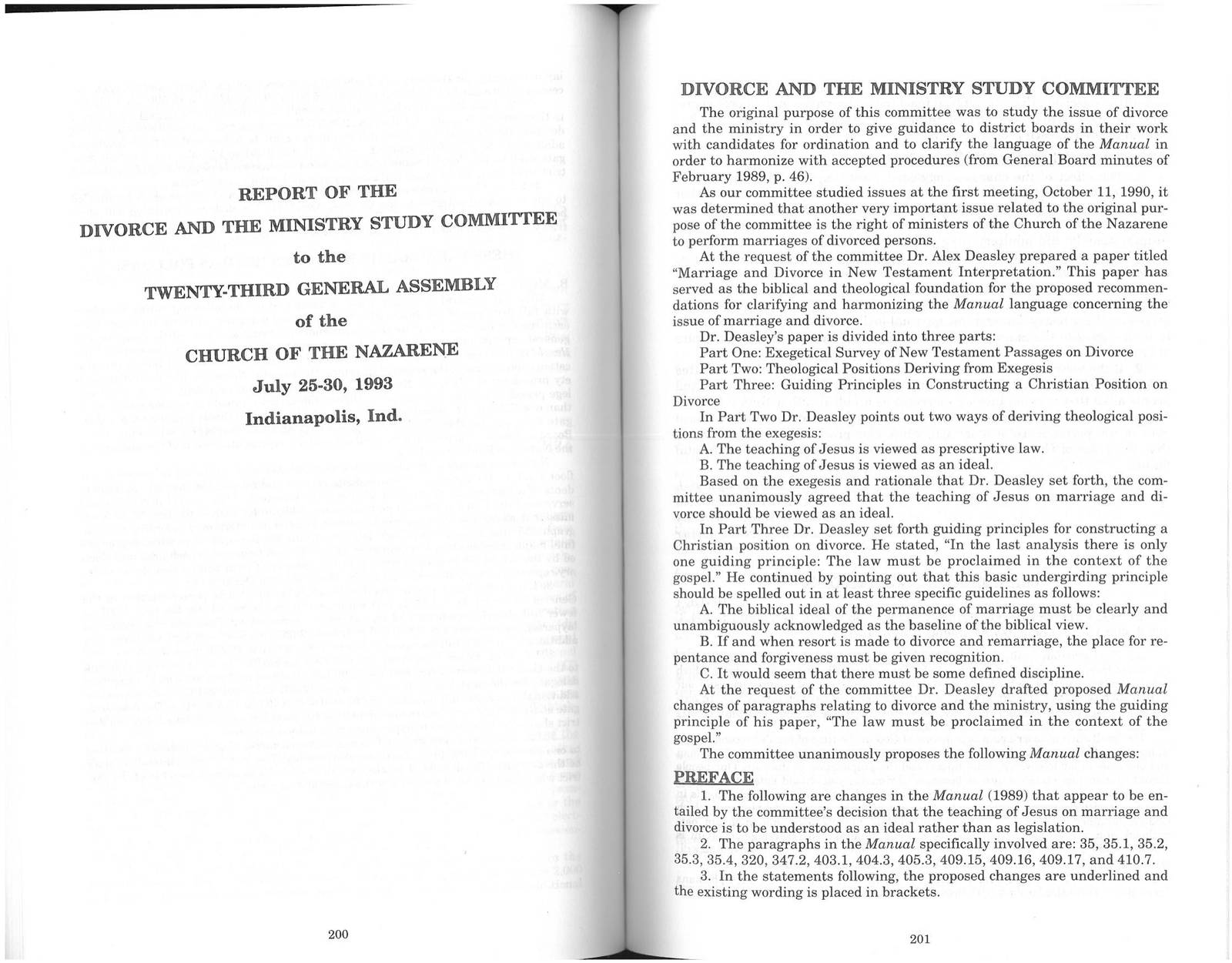
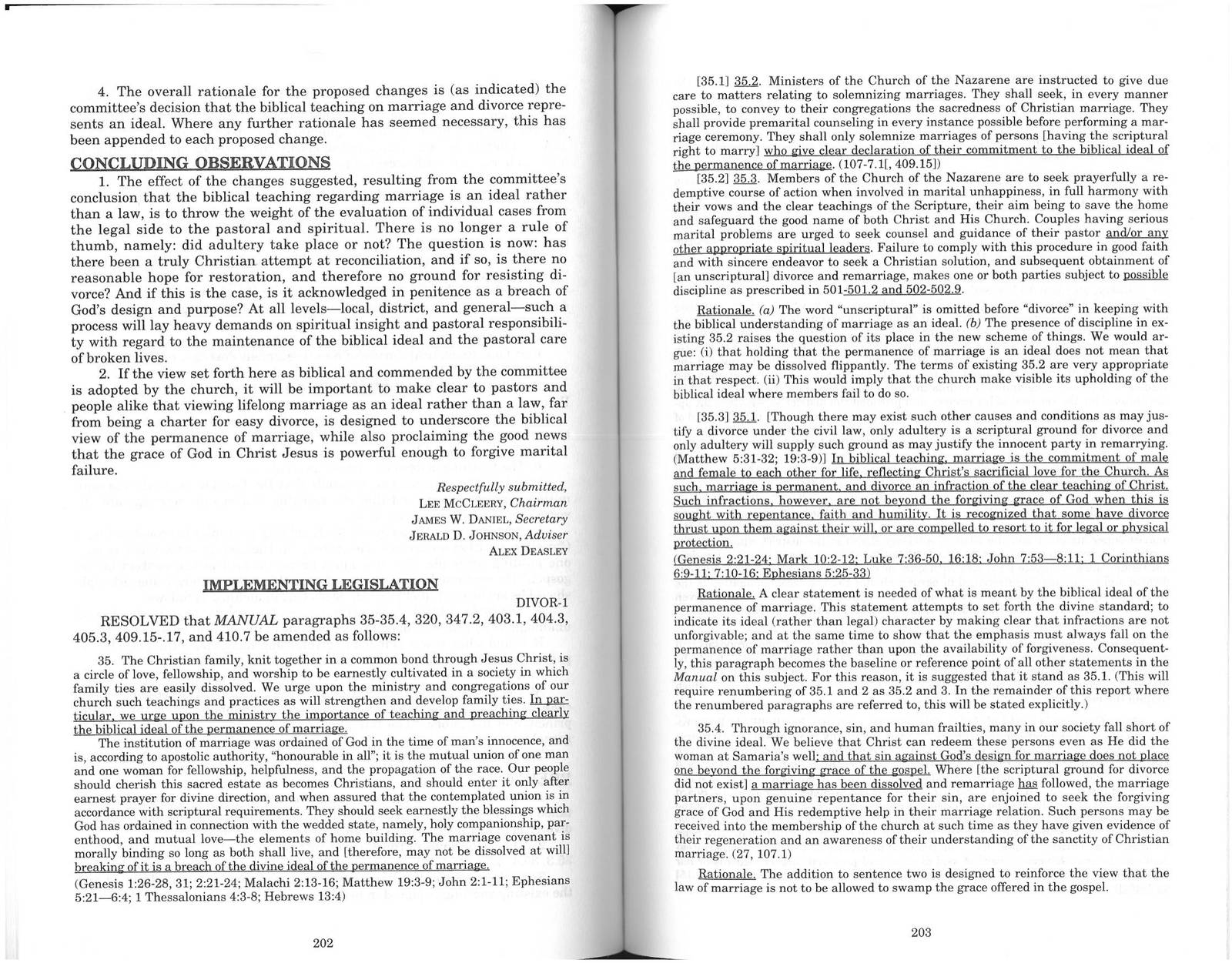
Both documents are photocopies the Nazarene Archives in Kansas City supplied to Bruce Barnard in April 2016 for his Doctor of Ministry research. He has shared them for this project. Anyone can ask the Archives for them.
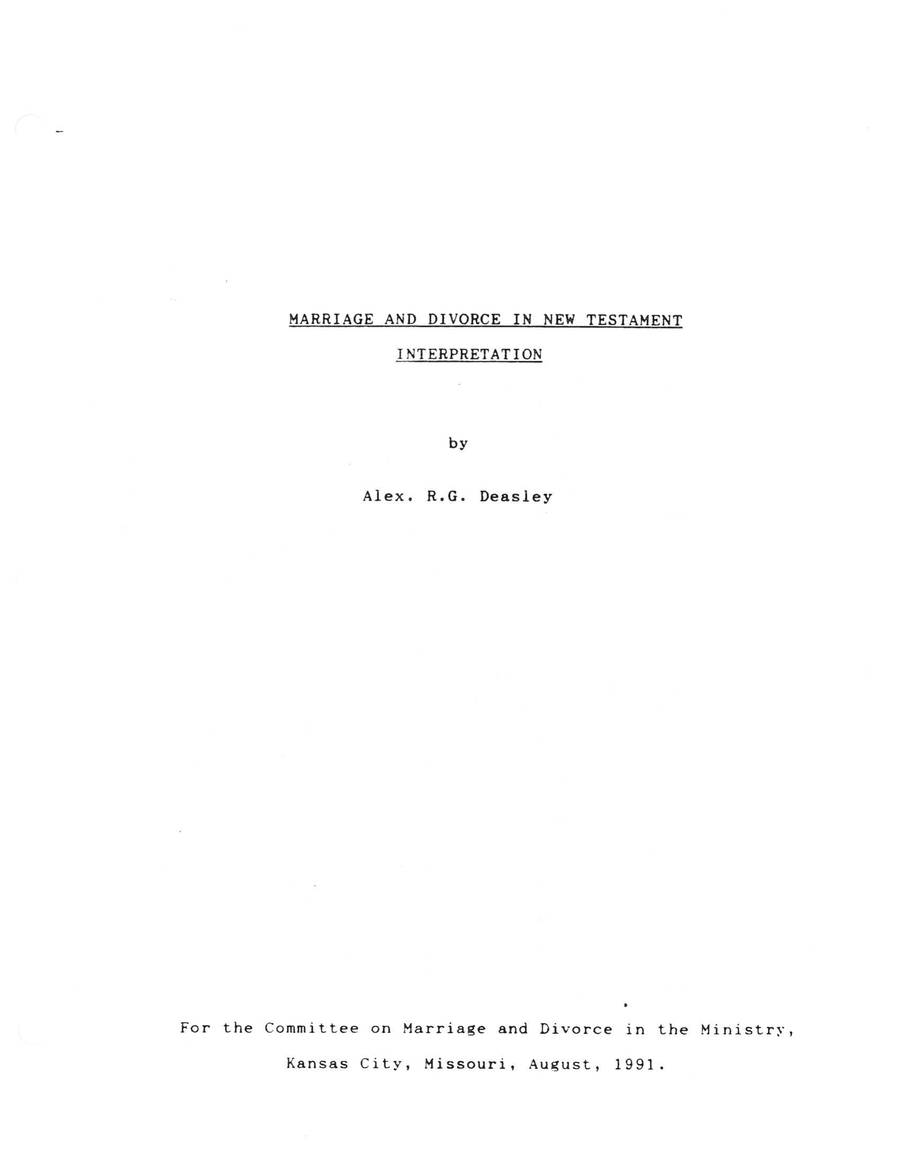
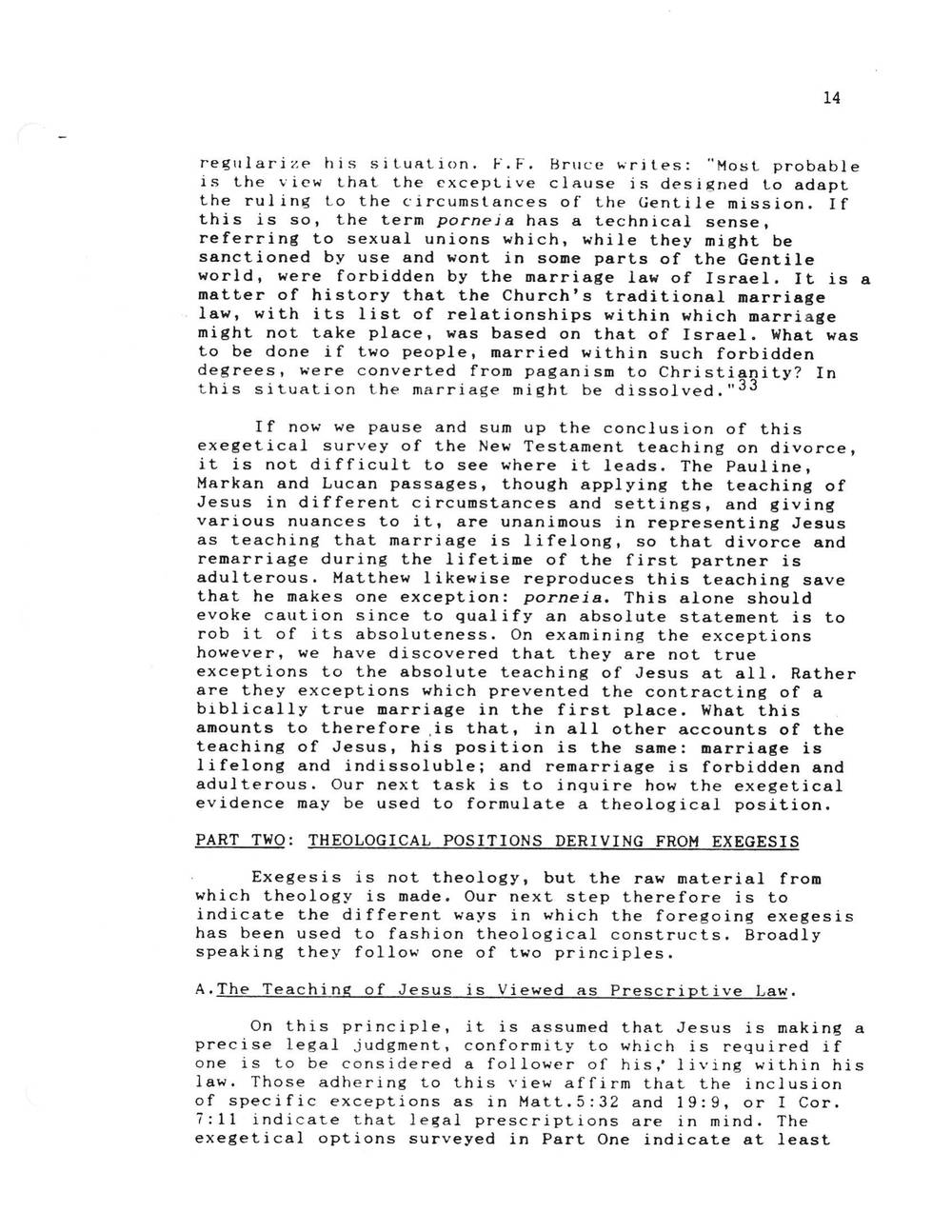
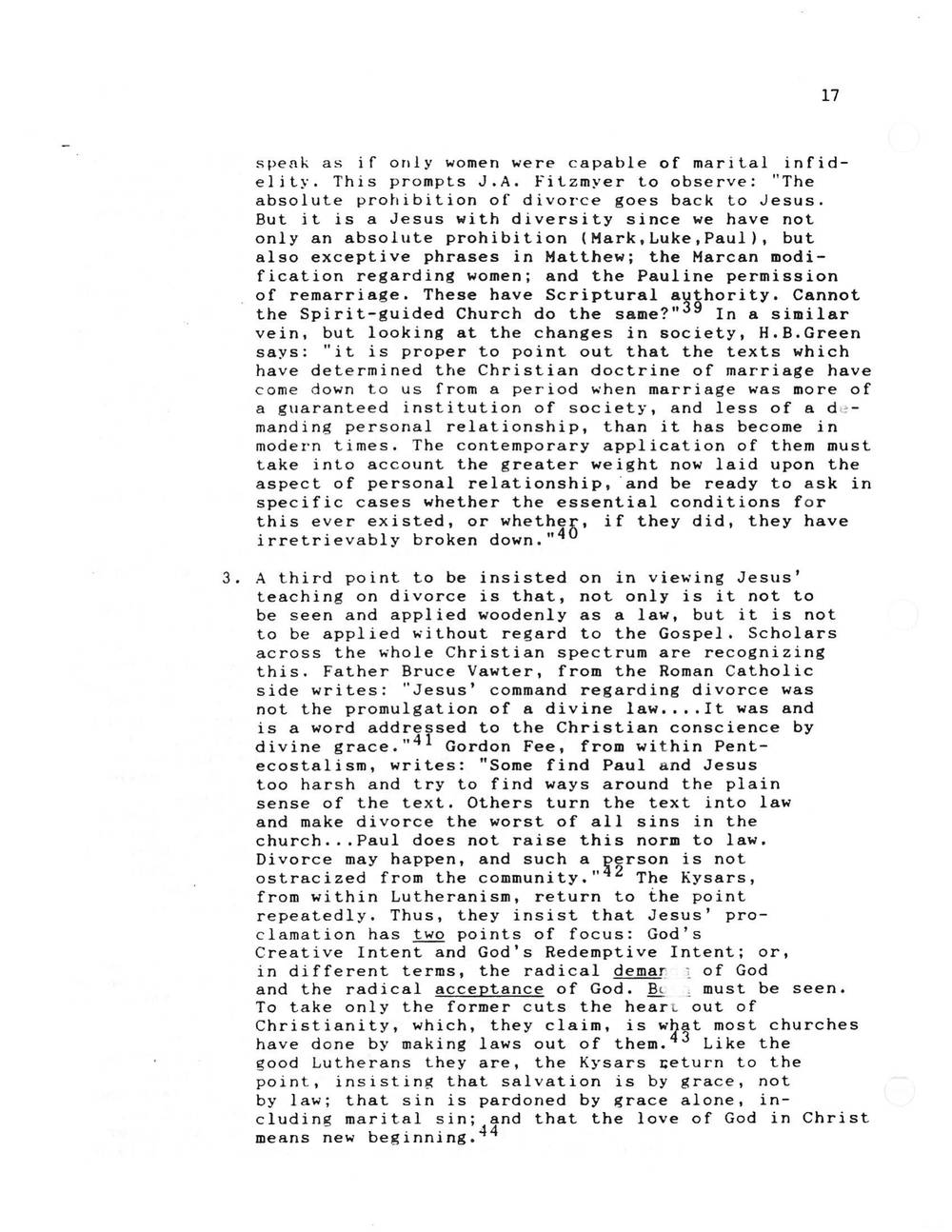
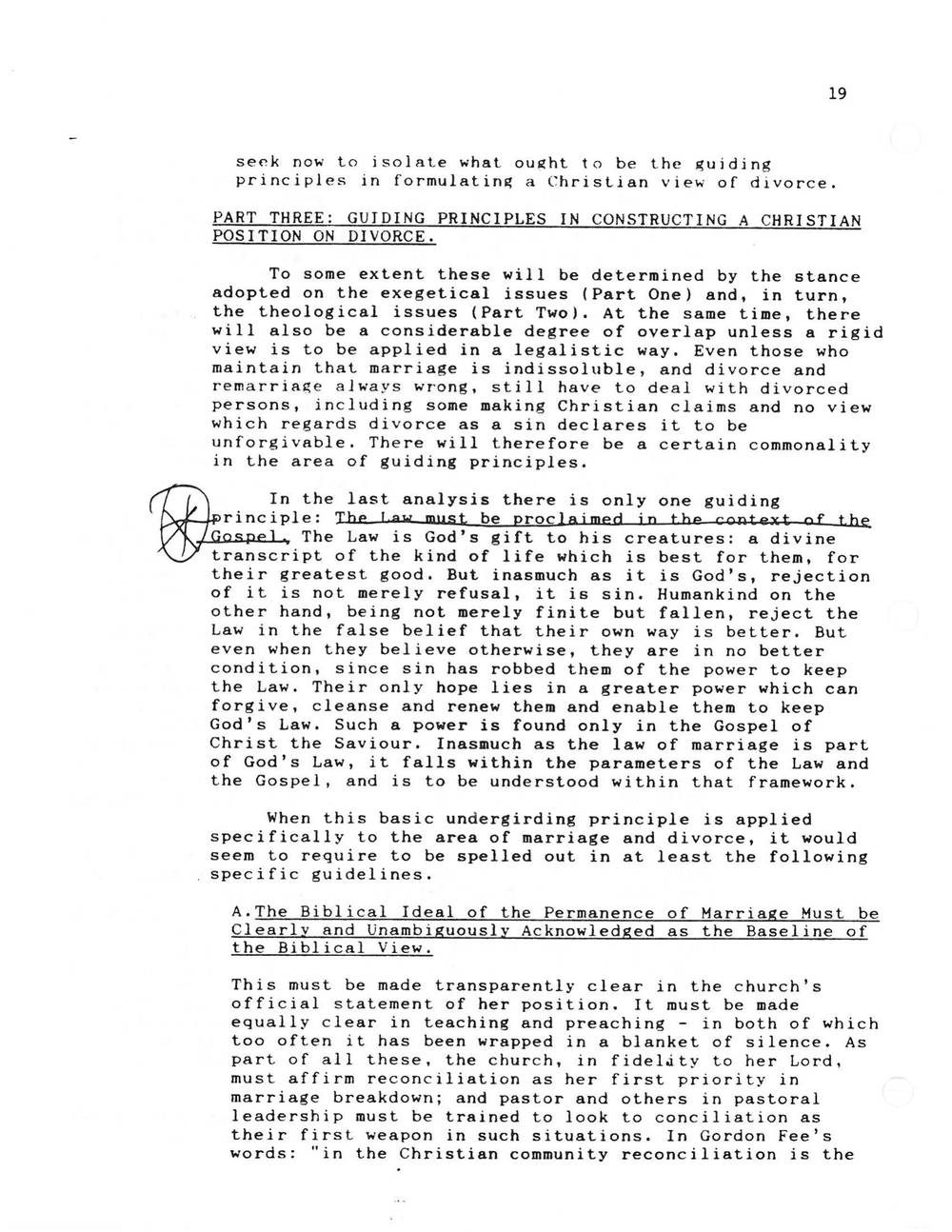
Alex R. G. Deasley, "Marriage and Divorce in New Testament Interpretation"
This paper is the "biblical and theological foundation" the committee's report names. It has three parts: an exegetical survey of the New Testament divorce texts, the two ways of building a theological position from them ("prescriptive law" or "an ideal"), and guiding principles.
- The exegesis is strict. Paul, Mark and Luke present Jesus as teaching that "marriage is lifelong and indissoluble; and remarriage is forbidden and adulterous," and Matthew's exceptions "are not true exceptions" (14).
- The method is what changes. Quoting F. F. Bruce, Deasley asks whether it is wise to give Jesus' rulings "legislative force," or better "to let his words stand in their uncompromising rigour as the ideal" (15–16).
- The church may apply Jesus' teaching as the New Testament writers did. He quotes Fitzmyer: the variations in Mark, Matthew and Paul "have Scriptural authority. Cannot the Spirit-guided Church do the same?" (17).
- One guiding principle: "The law must be proclaimed in the context of the gospel" (19). This is followed by three guidelines: permanence as the baseline, room for repentance and forgiveness, and defined discipline.
Report of the Divorce and the Ministry Study Committee to the Twenty-Third General Assembly
- The committee was formed from General Board minutes of February 1989 to guide district boards on divorced candidates for ordination. At its first meeting, on October 11, 1990, it added the question of ministers performing marriages of divorced persons.
- "The committee unanimously agreed that the teaching of Jesus on marriage and divorce should be viewed as an ideal."
- The report gives the exact Manual amendments. The new baseline paragraph reads: "In biblical teaching, marriage is the commitment of male and female to each other for life… It is recognized that some have divorce thrust upon them against their will, or are compelled to resort to it for legal or physical protection."
- "There is no longer a rule of thumb, namely: did adultery take place or not?"
Nazarene publications, public online
Herald of Holiness 82.7, July 1993
The committee's report as printed for the whole church, pp. 5–6. Wesleyan Holiness Digital Library
Herald of Holiness 57.19, June 26, 1968
W. T. Purkiser's editorial, pp. 10–11: "A four-year study of marriage and the family is being considered at this General Assembly." Wesleyan Holiness Digital Library (PDF)
Herald of Holiness 61.15, July 19, 1972
W. T. Purkiser's editorial "Church Membership and Divorce," pp. 16–18, written weeks after the 1972 General Assembly. It reports that two commissions studied the question for eight years, that the Assembly adopted the commission's report ("the vote was almost unanimous"), and prints much of the report, including its key distinction: "The Bible is explicit on the subject of divorce. The Commission does not alter that. The Bible is silent on the subject of specific requirements for church membership." Quotations were checked through a page-reading tool and should be confirmed against the scan. Wesleyan Holiness Digital Library (PDF)
Journal of the Thirtieth General Assembly (2023)
The church's historical statement, pp. 14–15, records the 1972 change ("permit church membership for divorced persons 'at such a time as they have given evidence of their regeneration'") and the 1993 adoption of the committee's report, after which divorced persons "are not automatically disqualified from serving as ministers."
J. Kenneth Grider, "Wesleyans and Homosexuality" (1999–2000)
Prepared for the Wesleyan Theological Society and withdrawn. The earlier Nazarene use of the usury comparison. Posted online (PDF)
Unpublished research
Bruce Barnard, four Doctor of Ministry papers, George Fox Evangelical Seminary / Portland Seminary (2016–17)
"Cognitive Dissonance and the Progression of the Church on Major Cultural Norms" (April 2016) is the first place this page has found the 1993 divorce revision used as a precedent for the LGBTQ+ question. The other papers are "Nazarene Women Clergy's Response to LGBT+ Tension" (fall 2016), "Sex, Gender, and Identity Perspectives in the Church of the Nazarene" (spring 2017), and a working draft on group identity (fall 2017). The dissertation they were meant to launch was never completed. Cited with the author's permission.
Published scholarship (cited, not reproduced)
Alex R. G. Deasley, Marriage and Divorce in the Bible and the Church (Kansas City: Beacon Hill Press, 2000). The expanded study that grew from the 1991 paper.
Thomas Jay Oord and Alexa Oord, eds., Why the Church of the Nazarene Should Be Fully LGBTQ+ Affirming (2023).
Dale B. Martin, "Heterosexism and the Interpretation of Romans 1:18–32," Biblical Interpretation 3.3 (1995): 332–55.
Dale B. Martin, Sex and the Single Savior: Gender and Sexuality in Biblical Interpretation (Louisville: Westminster John Knox, 2006).
Reginald G. Watson, "Nazarene Clergy Responses to Homosexuality and Interactions with LGBT People" (PhD diss., Regent University, 2015).
The rest of the works cited are in the source ledger, marked by how each was checked.
Reported, not yet confirmed
Sam Powell recalls hearing from Frank Carver that Carver did the New Testament work for one of the 1964–72 commissions, with W. Shelburne Brown involved, and reached a reading close to Deasley's. The commissions themselves are now confirmed (see Purkiser 1972 above). Carver's part, and whether his reading appears in the reports, is not. The 1964, 1968 and 1972 General Assembly Journals should settle it.