“Pastor Wilma Green of the Plainville Church of the Nazarene is deserted by her husband. A divorce ensues.”
Does the divorce disqualify Wilma from future pastoral service?
A short documentary in eight reels
Twice in the last century the Church of the Nazarene met a hard question about marriage and membership. Both times it stopped, asked its scholars and pastors to study, listened, and then decided.
This is that story. It ends with a request, and an invitation to you.
Roll filmEvery church eventually meets a question its rulebook didn't see coming. It rarely arrives as theory. It arrives in a pastor's office, at a district board meeting, across a kitchen table.
When that happens, a church can let practice drift until the rule means nothing. It can fight it out on the floor of an assembly. Or it can do the slower, humbler thing, which the Nazarenes have done twice:
Study first. Then decide.
Reel 1

The first Manual of the Pentecostal Church of the Nazarene drew a bright line. Divorce was permitted for one cause only. Anyone who remarried outside that cause was, in the Manual's words,
“…divorced, where Scriptural grounds for divorce did not exist, and have subsequently remarried, are living in adultery.”
Manual of the Pentecostal Church of the Nazarene (1908), 37–38, as quoted in Barnard (2016)
Ministers were “positively forbidden” to marry anyone else. For decades the rule stood essentially unchanged, and the number of people it touched kept growing.
Reel 2

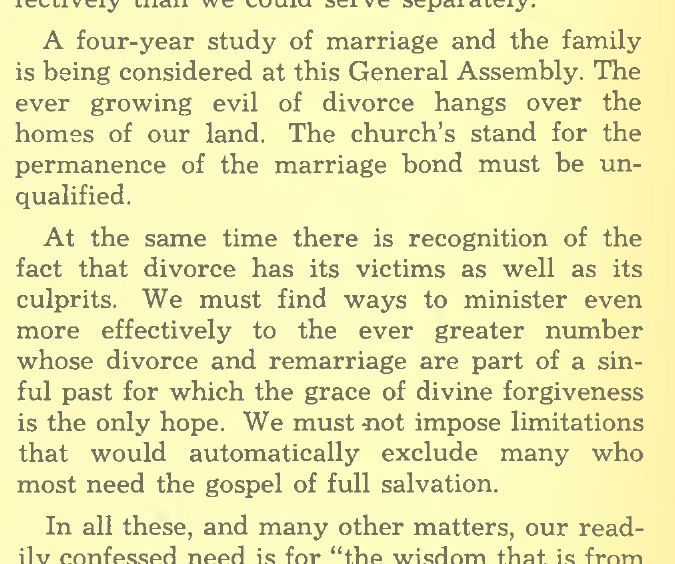
On the eve of the 1968 General Assembly, W. T. Purkiser, editor of the Herald of Holiness, wrote an editorial that held two convictions at once and refused to drop either.
“The church's stand for the permanence of the marriage bond must be unqualified.”
and in the next paragraph,
“We must not impose limitations that would automatically exclude many who most need the gospel of full salvation.”
He didn't choose between them. He pointed to a process: A four-year study of marriage and the family is being considered at this General Assembly.
Herald of Holiness 57.19 (June 26, 1968), 11
Reel 3

In June 1972, at Miami Beach, the Eighteenth General Assembly adopted the commission's report. Divorced and remarried people could now become members
“…at such a time as they have given evidence of their regeneration.”
Journal of the Thirtieth General Assembly (2023), 15
Ministers stayed under the historic standard. The church hadn't given up its teaching on marriage. It had studied how to live that teaching with the people actually in its pews.
Herald of Holiness 61.15 (July 19, 1972), 16–18; Journal of the Thirtieth General Assembly (2023), 14–15
Reel 4

Twenty years later the question came back, this time about ministers. In February 1989 the General Board formed a committee to give guidance to district boards in their work with candidates for ordination.
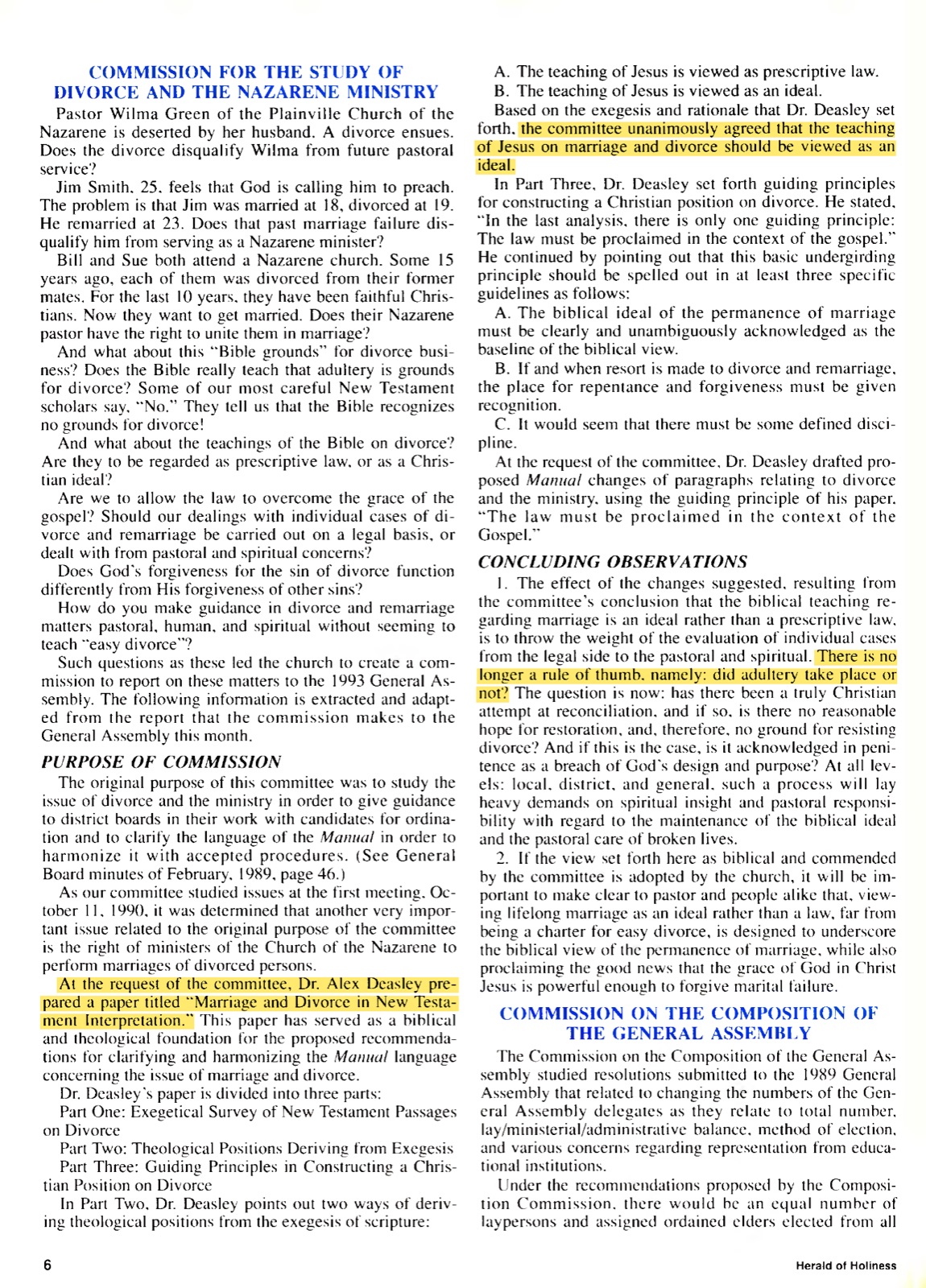
When the Herald of Holiness told the whole church about the study in July 1993, it didn't open with doctrine. It opened with people.
“Pastor Wilma Green of the Plainville Church of the Nazarene is deserted by her husband. A divorce ensues.”
Does the divorce disqualify Wilma from future pastoral service?
“Jim Smith, 25, feels that God is calling him to preach.” He married at 18, divorced at 19, and remarried at 23.
Does that past marriage failure disqualify him from serving as a Nazarene minister?
Bill and Sue were each divorced years ago. “For the last 10 years, they have been faithful Christians. Now they want to get married.”
Does their Nazarene pastor have the right to unite them in marriage?
The cases as the Herald presented them, July 1993, p. 6. The names appear to be illustrations, not real people.
“Such questions as these led the church to create a commission.”
Herald of Holiness 82.7 (July 1993), 6
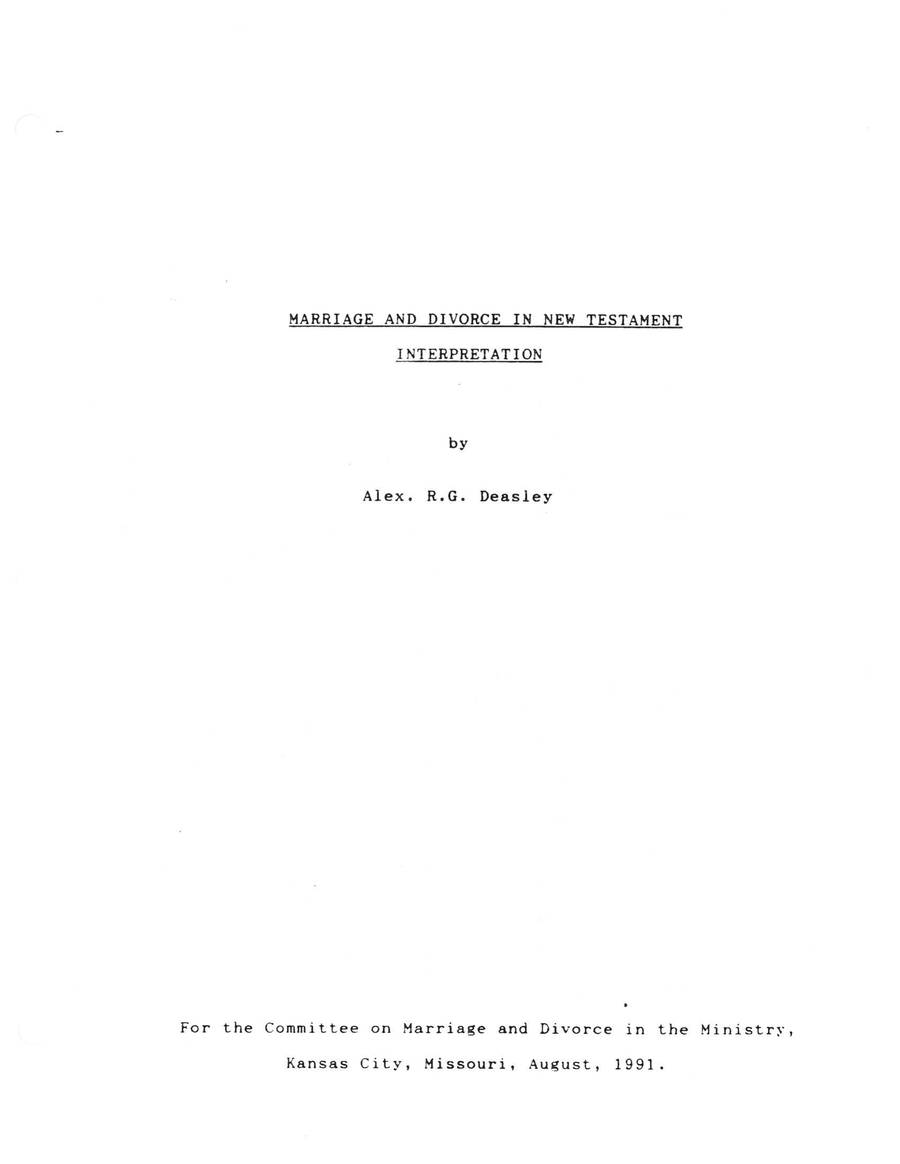
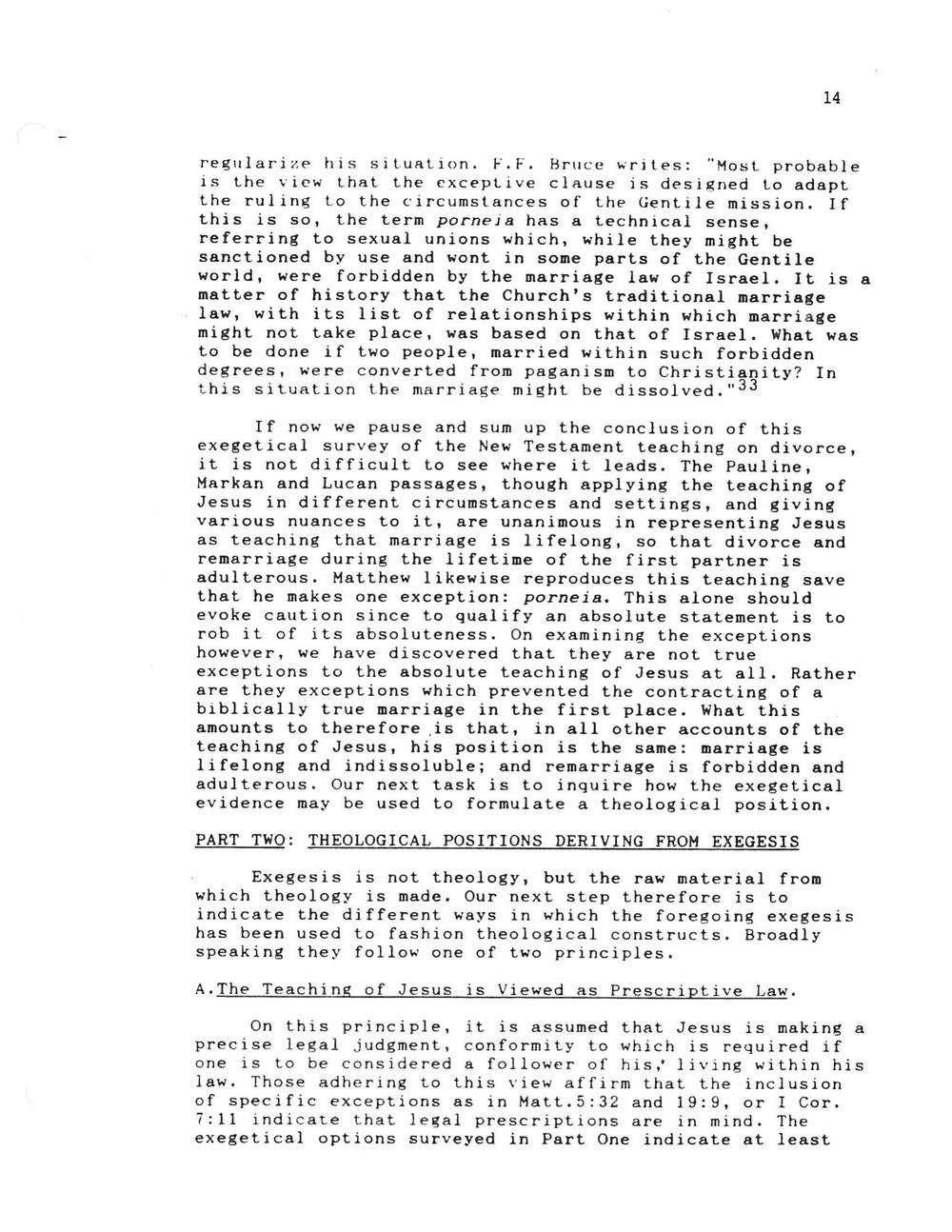
The committee asked Deasley for a paper. His reading of the texts was strict: Jesus taught that marriage is “lifelong and indissoluble.” Then he set out two ways a church could build on that reading.
A
Prescriptive law
Apply the words as a legal rule. Did adultery take place, or not?
B
An ideal
Hold the teaching up as the ideal, and weigh each case pastorally, in the light of the gospel.
“The committee unanimously agreed that the teaching of Jesus on marriage and divorce should be viewed as an ideal.”
Herald of Holiness 82.7 (July 1993), 6
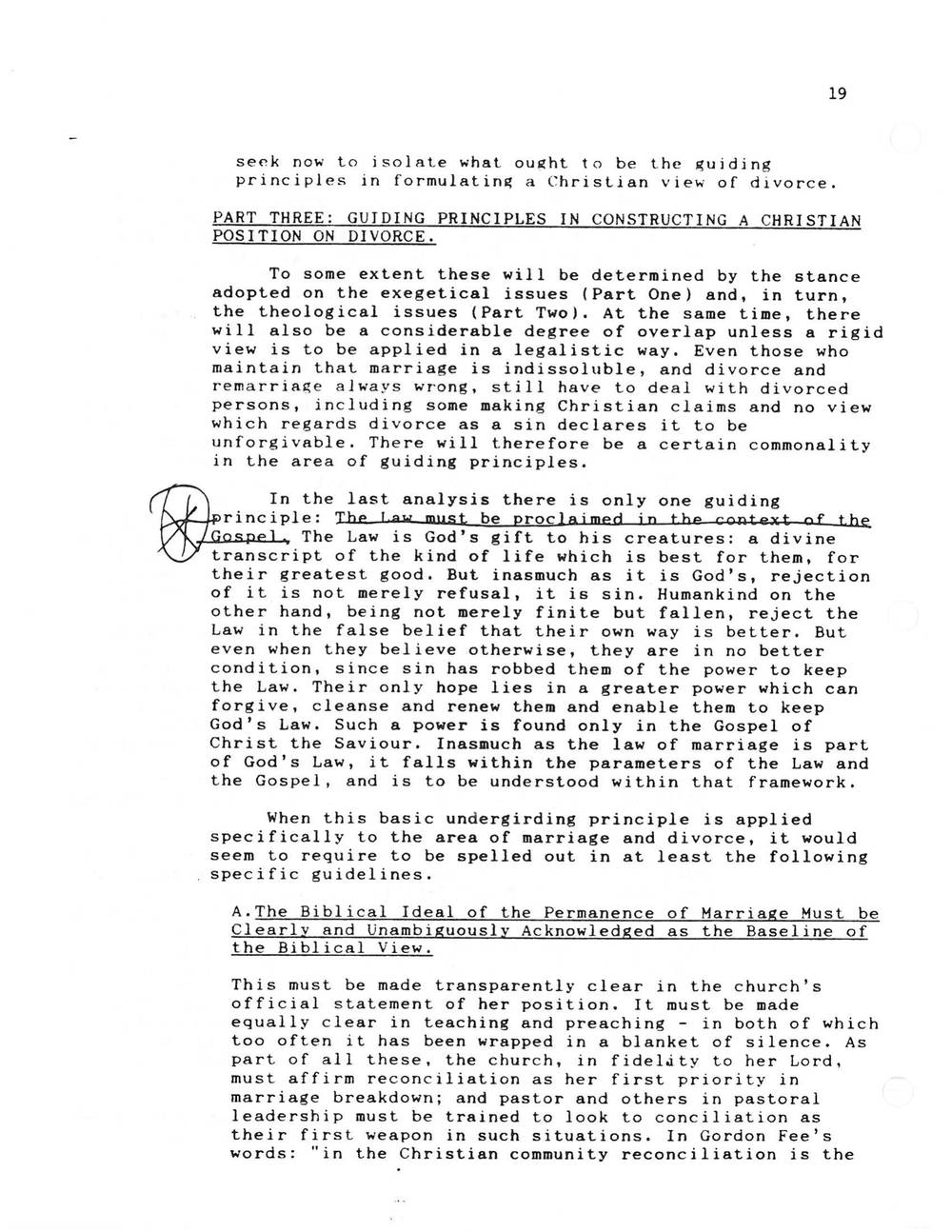
On page 19 of the Archives copy, a reader has marked one sentence in pen. The committee made it the rule for everything that followed:
“In the last analysis there is only one guiding principle: The Law must be proclaimed in the context of the Gospel.”
Alex R. G. Deasley, “Marriage and Divorce in New Testament Interpretation,” paper for the committee, Kansas City, August 1991, 19
Reel 5
Since 1989, paragraph 35.3 of the Manual had read:
¶35.3
Though there may exist such other causes and conditions as may justify a divorce under the civil law, only adultery is a scriptural ground for divorce and only adultery will supply such ground as may justify the innocent party in remarrying.
removed · 1993
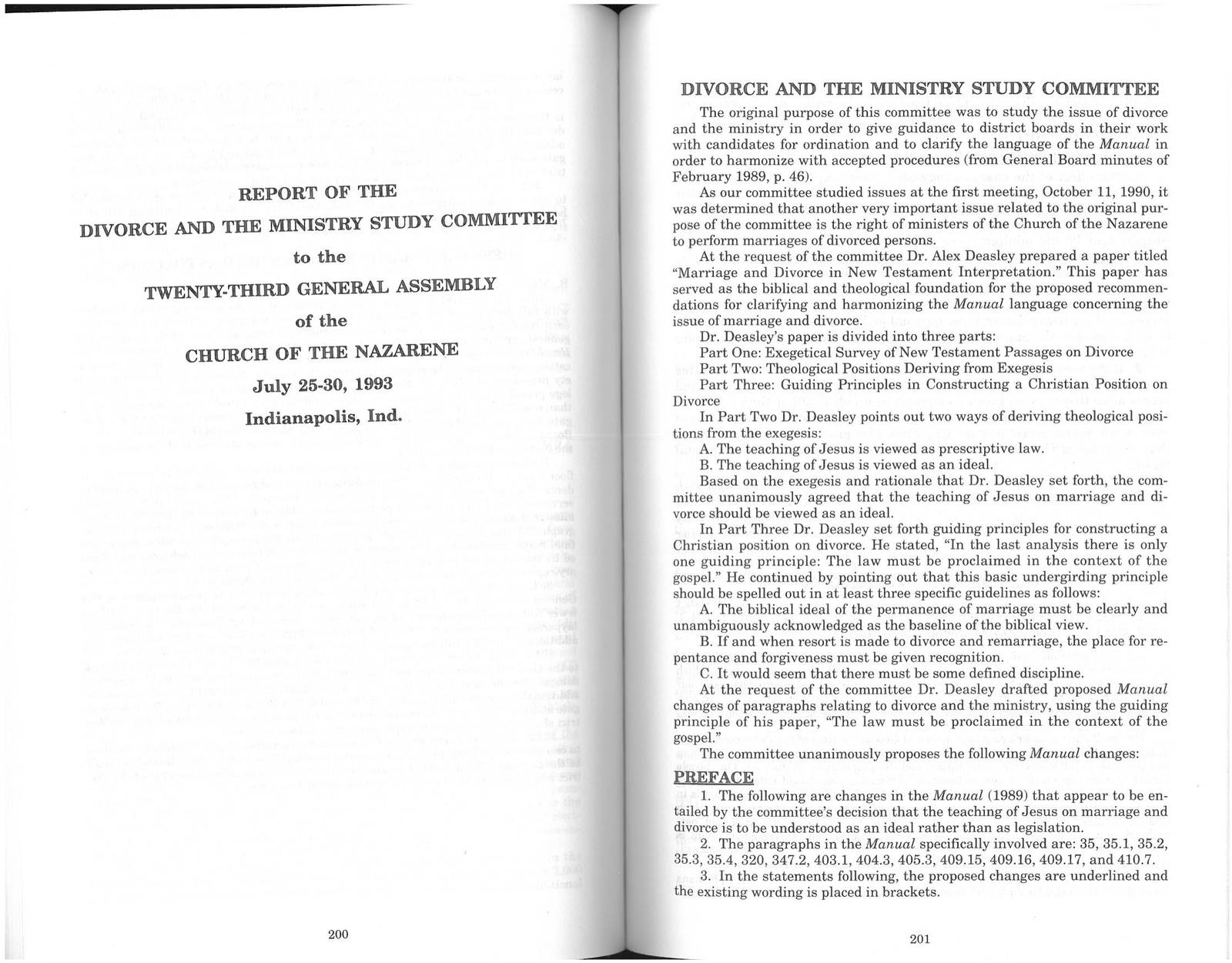
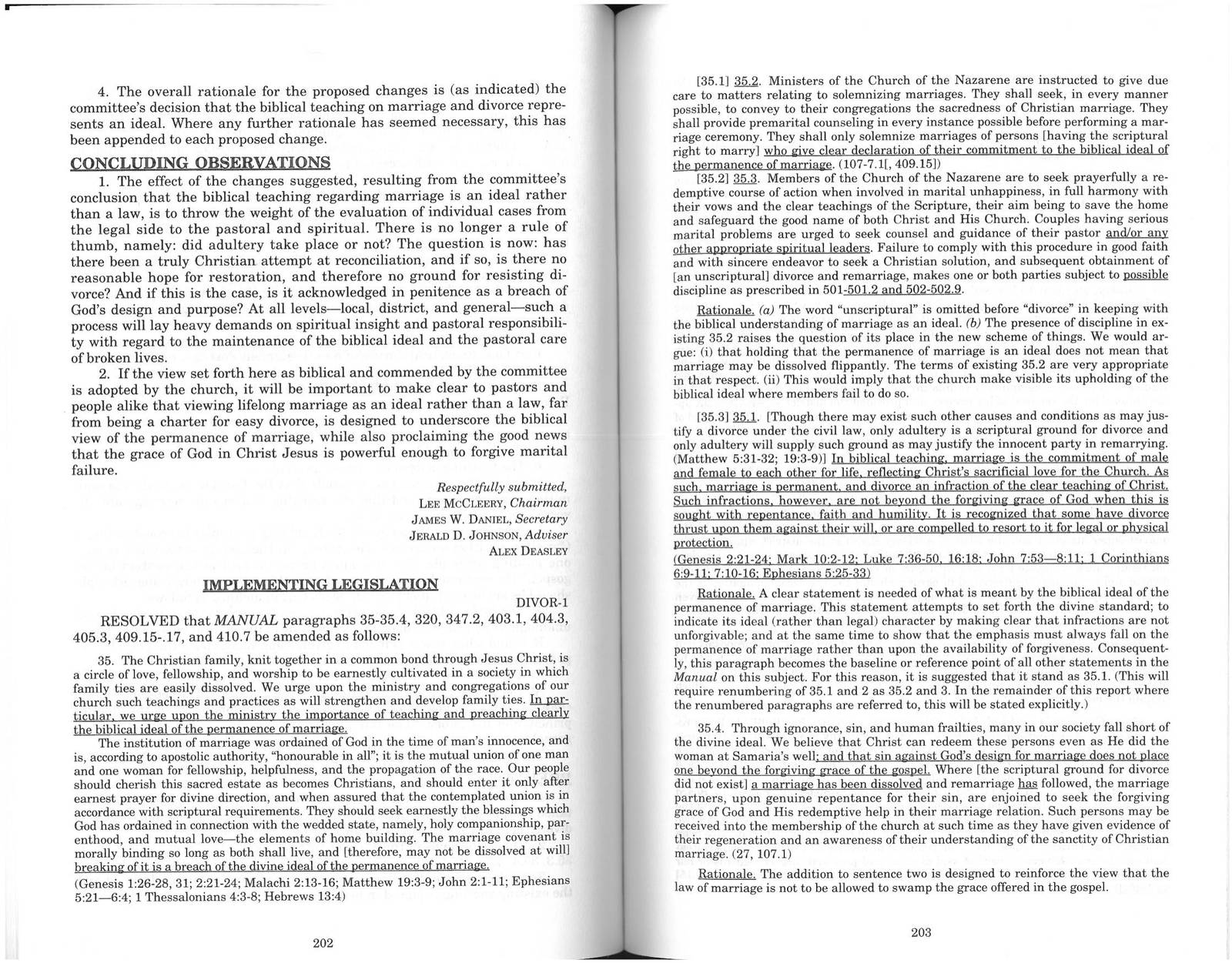
At Indianapolis, July 25–30, 1993, the Twenty-Third General Assembly adopted the committee's recommendations. The sentence came out. The committee's own summary of what that meant:
“There is no longer a rule of thumb, namely: did adultery take place or not?”
Report of the Divorce and the Ministry Study Committee to the 23rd General Assembly (1993), 200–206; Herald of Holiness 82.7, 6
Real pages from the Nazarene Archives and the Herald of Holiness. Tap to read.
Reel 6

Today pastors, district advisory boards and credentials boards are working through questions of same-sex attraction and faithfulness, in real cases with real names, and often without much guidance. The Manual itself names the weight of it:
“…the faithful outworking of these statements as congregations is complex and must be navigated with care, humility, courage, and discernment.”
Manual 2023, ¶31
It also calls the implication of its teaching “costly.” A 2015 doctoral study of Nazarene pastors found the question had touched the lives of all the participants.
R. G. Watson, PhD dissertation, Regent University (2015), 310–311
The church has a way of meeting moments like this.
It has used it twice.
Reel 7
A resolution to the 31st General Assembly asking the Board of General Superintendents to convene a representative study committee on pastoral guidance concerning human sexuality, reporting to the next Assembly.
You don't have to agree on the answer
to agree the church should study the question.
Resolutions due
— days
Must reach the General Secretary by December 1, 2027 (Standing Rule 16e, Manual ¶912).
Who can submit it
A district, or five delegates
A district assembly or district resolutions committee, or any five or more members of the 2028 General Assembly.
Especially valuable now: sponsors from more than one world region, and sponsors who hold the church's present teaching. In 1968 and 1989, people who held the church's teaching on divorce supported study. That is exactly why it worked.
Reel 8

When the Herald told the church about the 1993 study, it began with Wilma, Jim, and Bill and Sue. A study committee in 2029 should begin with people too.
If this question has touched your life, your ministry, or your family, whatever you believe about it, we would be honored to hear from you. Pastors and board members who have had to decide a case are especially needed. So are parents, and LGBTQ+ people who grew up Nazarene or still are.

In memory of
Alex R. G. Deasley
New Testament scholar, Nazarene Theological Seminary · died March 9, 2026
Primary sources
Herald of Holiness 57.19 (June 26, 1968), 10–11 · 61.15 (July 19, 1972), 16–18 · 82.7 (July 1993), 5–6, at the Wesleyan Holiness Digital Library
A. R. G. Deasley, “Marriage and Divorce in New Testament Interpretation,” committee paper, August 1991
Report of the Divorce and the Ministry Study Committee to the 23rd General Assembly (1993), 200–206
Journal of the Thirtieth General Assembly (2023), 14–15, 207 · Manual 2023, ¶¶31, 912
With thanks to
Bruce Barnard, whose 2016 Doctor of Ministry paper first drew the 1993 comparison, and who obtained the Archives copies
The Nazarene Archives, Kansas City
Further scholarship
Deasley, Marriage and Divorce in the Bible and the Church (2000) · R. G. Watson, Regent University PhD dissertation (2015)
How this was made
The idea, the sources and the direction come from a Nazarene layperson. Research and writing were done with an AI assistant, from documents supplied to it. No specialist has reviewed it. The documents shown are real scans. The atmospheric photographs are AI-generated illustrations and do not depict real people, places or events.
The full research dossier · Sources · Draft resolution
Fin.